
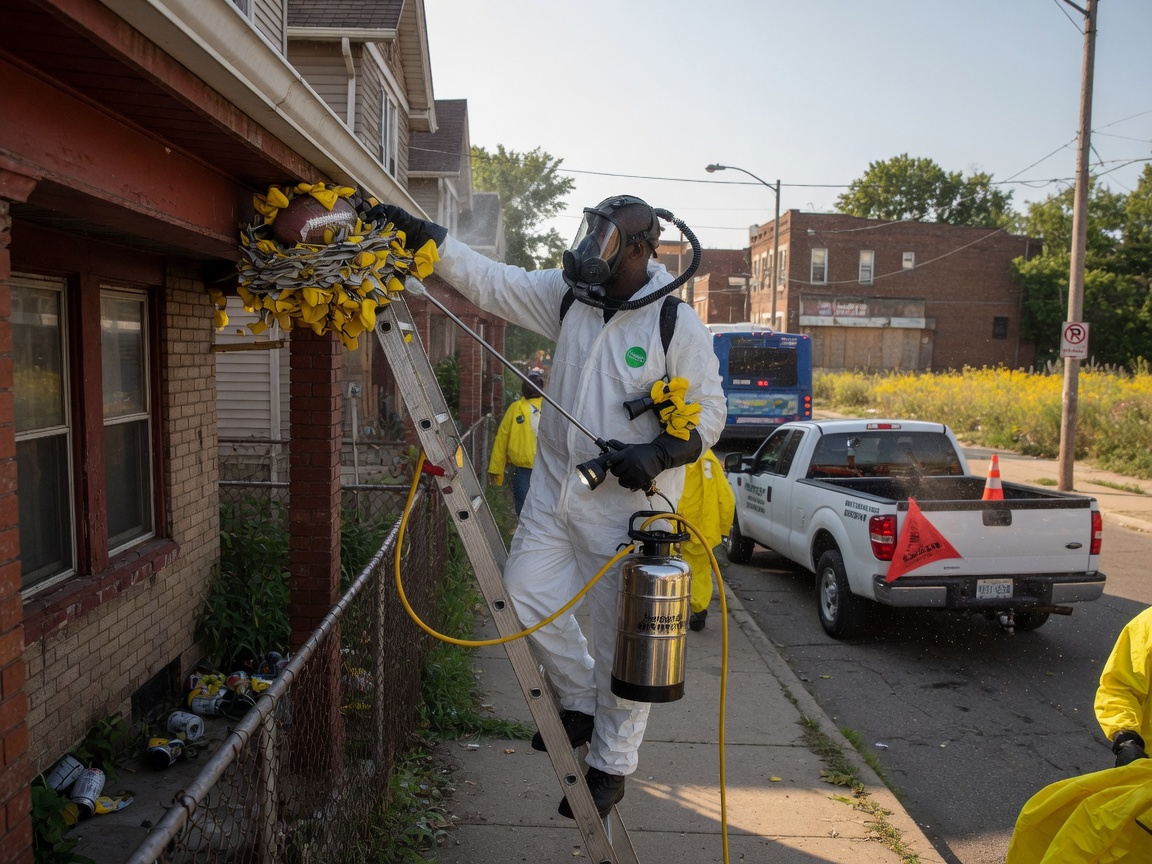
Yellow jackets in Detroit often establish colonies in wall voids of pre-1940s homes common in Boston-Edison and Indian Village. These brick and wood-frame structures create protected cavities where queens overwinter and expand during warm summers. Technicians use dust formulations labeled for voids to reach nests without opening walls, then seal entry points to prevent re-entry. Underground nests appear in yards near Eastern Market and Belle Isle Park where soil disturbance from construction leaves loose pockets.
Summer heat accelerates colony growth while fall cooling drives foraging near Comerica Park and Campus Martius Park events. Treatments must account for Michigan pesticide rules restricting certain products near waterways and public spaces. Homeowners in Woodbridge and Mexicantown frequently report stings when trimming ivy or opening sheds where aerial nests hide. Proper identification separates yellow jackets from paper wasps to avoid unnecessary treatments that miss the actual colony.
Edge cases include nests inside soffits of two-story homes in Palmer Park where ladder access and electrical lines complicate removal. Multiple queens in late-season colonies require follow-up visits after initial knockdown. Technicians carry epinephrine kits on every call because allergic reactions remain common in dense neighborhoods with limited hospital access during rush hour.
Technician insight
In Detroit, the thing that catches most people out with Yellow Jacket Control is how 1920s balloon-frame homes in neighborhoods like Woodbridge let colonies travel between floors through unblocked stud bays, especially after warm summers push them toward indoor warmth.
Corktown duplex wall void
Homeowner reported stings while using a second-floor closet. Inspection found an active colony inside exterior brick siding that had entered through a rotted window frame. Dust was applied through the void and the entry sealed. Follow-up confirmed no activity and the family resumed normal use of the space.
Yellow Jacket Control Services We Offer
✓Attic Yellow Jacket Nest Removal
Locates and eliminates colonies in attic insulation of older Detroit homes using void dusts that reach combs without disturbing ceilings.
✓Wall Void Treatment
Injects targeted dust into siding gaps common in Boston-Edison and Corktown properties to kill hidden nests while minimizing interior disruption.
✓Underground Nest Control
Treats ground nests in yards near Eastern Market and Belle Isle using soil drenches that reach chambers without excavation.
✓Soffit and Eave Colony Removal
Removes nests from roof overhangs on two-story homes in Indian Village and Palmer Park where ladder work and power lines require careful planning.
✓Yellow Jacket Baiting Program
Places protein and sugar baits around commercial properties in Midtown and near Ford Field to reduce foraging pressure without direct nest contact.
Yellow Jacket Control Cost in Detroit, MI
| Service | Typical Range | What Affects It |
|---|---|---|
| Ground-level nest removal | $175–$300 | Lower in open yards; higher near fences or utilities in Corktown. |
| Attic or wall void treatment | $250–$450 | Increases with insulation depth and multiple access points in older Wayne County homes. |
| Soffit or eave colony | $300–$550 | Higher on two-story structures in Indian Village due to equipment needs. |
| Baiting program setup | $125–$225 | Per visit; scaled for commercial sites near Eastern Market. |
Ranges are typical for Detroit, MI and confirmed with an exact written quote before any work starts.
How it works
- 1
Site Inspection
Technician examines exterior siding, eaves, and ground for activity trails while noting nearby landmarks and property age.
- 2
Nest Location
Uses listening devices and visual checks to pinpoint colony without unnecessary wall cuts in historic Detroit structures.
- 3
Targeted Application
Applies approved dust or liquid directly into nest voids during low-activity periods to protect residents and pets.
- 4
Entry Sealing and Follow-Up
Closes access points and schedules return visit to confirm elimination before seasonal cooling drives new queens indoors.
Pricing
Cost depends on nest height, accessibility, and number of colonies.